
Young County Busted Mugshots and Records
A booking record starts the moment someone enters Young County Jail. That fact matters. It makes the county system the main place to search, not the arresting agency. The Sheriff's Office, Graham Police, Olney Police, or another department may have made the arrest. Once custody passes to the jail, the county record takes over. Not every arrest ends there, though. A citation and release, a transfer, or an arrest by another authority can leave a separate paper trail.
The phrase Young County Busted Mugshots describes a records lookup, not a photo gallery. The public roster is a searchable custody source. Its detail page returned a placeholder instead of a booking image. Names can shift between systems, too. What a jail record lists at booking may differ from what a court file shows later, since filings change as a case moves. A missing roster entry proves nothing. Custody status, timing, or the arresting agency can all explain the gap. Some records simply live outside the county-jail system.
Young County Booking Record Fields
The public results table keeps things lean. You get an arrest number, the inmate's name, the book date, and the charge. A detail page can add more, like charge entries, bond amounts, and release details. None of that replaces a court file, though. It exists to help you pin down the right jail record. Book date refers to the intake event itself. The charge is what was listed at that stage, and a release date, when one appears, only tells you the person left that jail. It says nothing about how the case ended.
| Field | What it can show |
|---|---|
| Arrest number and inmate name | Identifiers for matching the roster entry and a later request. |
| Book date and release date | County-jail intake and, when present, release from that jail record. |
| Charge and bond | An charge and a financial or court-set condition, not a verdict. |
| Head-image location | A source field that served a no-photo placeholder in the inspected public detail. |
| Hold or charge text | Custody notation that may require confirmation from the responsible agency. |
The detail schema holds still more. It can include aliases, an internal person identifier, demographics, physical-description fields, and charge-level dates. Sensitive material like that has no business being republished. A careful lookup grabs only what it needs to tell one record from the next. Then it goes back to the official custodian with questions. Physical descriptors, birth dates, and alias lists should never become somebody's new public index.
Note: A roster entry is a point-in-time custody record, so matching a name calls for careful use of the date and arrest number.
Where Young County Busted Mugshots Appear
Start with official sources. They tell you who holds the record and the custody status. Young County has not published a written photo policy, a public photo collection, or a separate daily booking log. The roster remains the primary county-jail channel. When a record exists but is not online, a written request is the fallback. Other systems answer narrower questions. Think notifications, court outcomes, or a person now in state or federal custody.
| Channel | Custody or record role | Public photo status | How to use it |
|---|---|---|---|
| Young County Current Jail List | Current or rolling Young County Jail lookup | Inspected public detail served a no-photo placeholder | Search a beginning date and starting inmate name. |
| Young County Sheriff's Office records route | County-held booking or jail material | Record-specific response only | Submit a written request and ask for the correct custodian. |
| VINELink | Sheriff-directed custody-status notifications | No photo function | Use separately from the jail roster. |
| County court and clerk records | Case filing and disposition | Not a booking-photo source | Verify what happened after the booking stage. |
Local news can hand you a date or an agency name worth checking. It holds no booking authority, though. The same goes for commercial mugshot sites and aggregators. When an outside item clashes with the roster or a court file, the official custodian settles it. A photo floating around elsewhere does not mean Young County serves that same image through its roster today.
Search Young County Busted Mugshots Roster
The Current Jail List is the direct official lookup for anyone booked into Young County Jail. Its form takes a beginning date in MM/DD/YYYY format and a starting inmate name. Blank fields read as ALL in the interface. That is not a full historical archive or a live feed. Think of it as a date-searchable roster with its own As-of signal. Results can be paged through a Next control.
| Roster control or result | Meaning |
|---|---|
| Beginning date | Starting date for the lookup, entered as MM/DD/YYYY. |
| Starting inmate name | Name starting point in the roster ordering, not a promise of full-text matching. |
| As-of date | The roster's displayed freshness signal for that result view. |
| Result fields | Arrest #, Inmate Name, Book Date, and Charge. |
| Next | Control for additional result pages. |
The official Young County roster search shows the date and name controls used for a county-custody lookup.
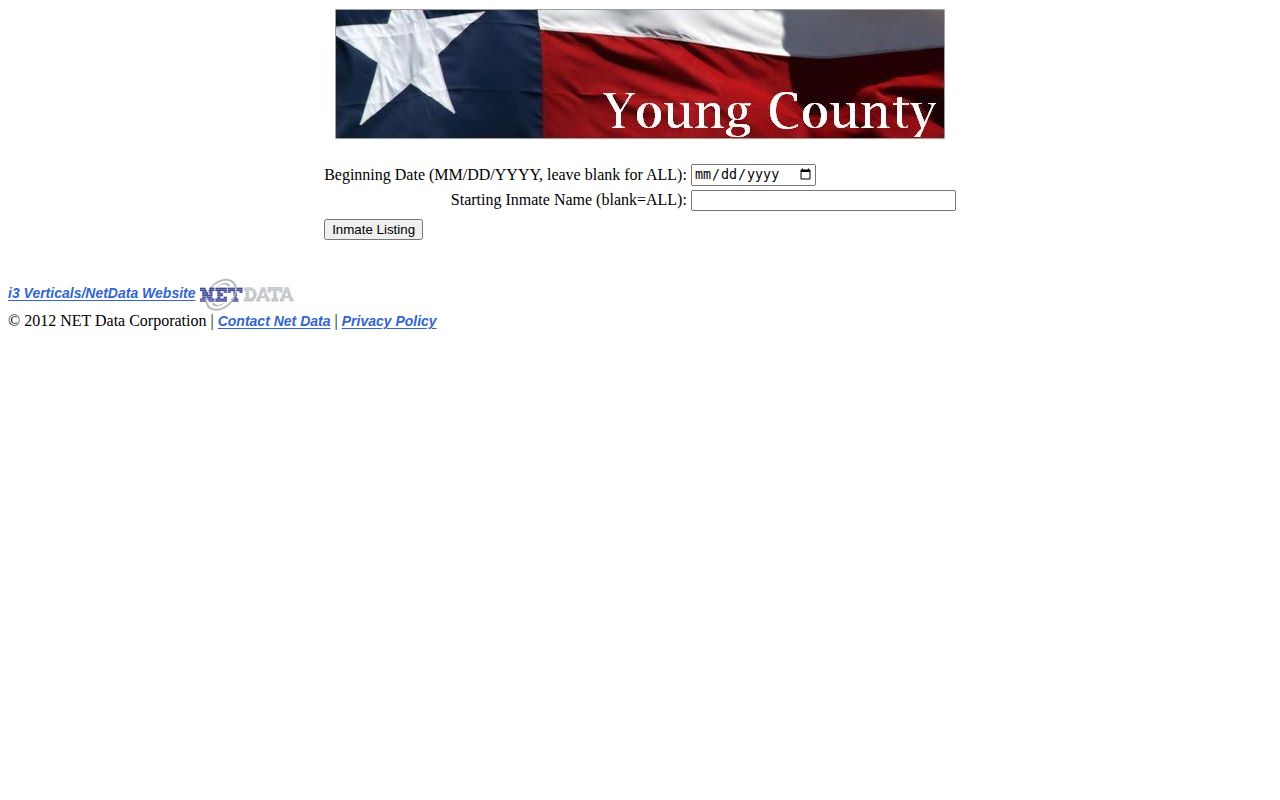
The form is a search tool, not a photo display. It runs a focused name or date search without hosting any person's image.
- Enter the known beginning date, then add a starting inmate name when available. Leave fields blank only when the interface's ALL option fits the search.
- Read the As-of date before treating the result as current. Record the arrest number, book date, and charge from any matching row.
- Open the detail only to compare the official entry. A no-photo placeholder means no public booking photo was served in that inspected response.
- Use the arrest number and date range for a later request or court inquiry. Do not infer a disposition from the roster alone.
Young County Roster Is Photo-Limited
The roster is built well enough to identify a booking. Its public photo presentation is limited, however. The detail page carried a head-image location that resolved to images/nomug.jpg. In plain terms, no booking photo was served through that roster response. That does not mean the sheriff never takes one internally. Nor does it mean every photo stays hidden, or that an agency must hand one over on request.
This distinction matters for honest record keeping. Someone can have a county booking record with no public image attached. An outside publication showing a picture proves nothing about what the county serves now, or even whether the image matches the right person. The roster's photo limits point you toward the agency records route for specific questions, not toward building a replacement image index.
Young County Busted Booking Timing Limits
How current is the Young County busted roster? Timing drives the answer, and nobody has pinned it down in public. The county promises no same-day booking entries. There is no fixed refresh interval. No deadline exists for when a new arrest must appear. Classification, release, and plain system lag can all affect the list. Check the As-of date on the page. It tells you how fresh the data claims to be, nothing more.
Searching stays flexible, at least. Enter a single day and you get a same-day-style lookup. Start from an earlier date and results can stretch across several dates. A broad query has returned months of entries before. That reach is not a guarantee for older records or future pulls, so treat the roster as a live window rather than an archive.
One caution deserves mention here. Do not confuse jail visitation hours with update timing. Those schedules answer different questions. Also note what does not exist: no RSS feed, no SMS alerts, no social booking feed, and no sheriff app for new bookings. None of those routes works in Young County.
Young County Booking Record Requests
When the roster falls short, the Texas Public Information Act is the tool. Put the request in writing and send it to the custodian of the record. For county booking material, that means the Young County Sheriff's Office at 315 N Cliff Dr, Graham, TX 76450, or 940-549-1555. Ask the office to confirm who should receive it. No general public-records email, photo-request form, fixed photo fee, or set turnaround time has been verified, so do not treat a district-clerk fee schedule as the price of a jail photograph.
The Texas Attorney General's public-information request guidance lays out the basics: requests must be written and must ask for records that already exist. Name the custodian, the date range, the arrest number if you have it, the record type, and your preferred format. A solid request covers the booking sheet, intake or release records, charge and bond fields, or a county booking photograph. It should also press the agency to state any fee, any exception it claims, anything it needs clarified, and when to expect an answer.
- Address the request to the jail or sheriff custodian and describe the existing record sought. Include the name, date range, and arrest number when known.
- Separate a request for a jail booking record from a request for a police incident report. The arresting agency may hold a different record.
- State the desired delivery format and ask for an estimate before any charge is incurred. Keep proof of delivery.
- Read the response for any withheld portion, stated exception, or production date. Seek clarification from the custodian when the routing is unclear.
Texas Government Code Chapter 552 holds the machinery. Section 552.021 opens the public-access route, Section 552.221 sets the prompt-production framework, and Section 552.108(c) covers basic arrest information. Peace-officer photos fall under a separate rule in Section 552.119, while Section 552.1425 governs certain later dissemination after notice. None of this promises that a particular photograph will be released. What the custodian says about the specific record is what controls.
Young County Busted Records and Texas Law
Texas public-record law is not a switch that makes every booking photo either public or private across the board. The request process matters, the exceptions tied to each record matter, and so does the office holding it. A roster that shows no photos decides nothing about whether another record can be requested. To fix an error in an agency record, go to the custodian that maintains it and state the precise problem.
Texas Business and Commerce Code Chapter 109 targets certain publishers of criminal-record information that charge for removal or correction. It carves out exceptions and a free correction or investigation path where it applies. It is not a universal deletion command, and it says nothing about whether a Young County booking record itself must be erased. Keep the exact source record, name the factual error, and use the publisher's current correction process rather than assuming a paid service is required.
Expunction and nondisclosure are different animals. Chapter 55A holds the current expunction procedure and its eligibility rules. The Texas State Law Library explains the split: expunction removes records from public view through the statutory process, while nondisclosure seals them from the public but leaves law enforcement access intact. Eligibility turns on the facts of the case and the law. The court order, how it is served, and how each custodian responds all matter.
Search engines add one wrinkle. After a source corrects or drops a stale item, an outdated result can linger for a while. The fix belongs with the search provider's own outdated-content process. That step addresses the listing or cached display; it does not change the status of the government record itself.
Note: A correction request, an expunction order, and a roster update are separate actions with different custodians and different legal effects.
Young County Roster and VINELink Split
The sheriff sends custody-status questions to VINELink, while the Current Jail List is the county's own booking lookup. The two serve different jobs. The roster identifies current or rolling jail entries along with the displayed As-of date. VINELink offers custody-status notifications where facilities participate. Neither replaces a court record, and VINELink is neither a photo source nor a substitute for a booking search.
| Question | Best Young County channel | Limit to remember |
|---|---|---|
| Was a person booked into Young County Jail? | Current Jail List | It is a roster snapshot, not a final case record. |
| Can available custody notifications be checked? | VINELink | Participation and notification behavior can change. |
| What did the court decide? | County court or district-court record | A booking entry cannot answer the disposition question. |
Young County has no sheriff app, booking alert, RSS channel, email list, or text feed for new bookings. Anyone wanting custody news has to check the jail list directly or use VINELink where available.
Young County Immigration Holds in Bookings
A Young County booking roster sometimes shows a hold notation that points to immigration custody. That is administrative text, plain and simple. It tells you the jail is holding someone at another agency's request. To learn where a separate legal matter stands, look to the official court or federal record rather than the roster line itself.
The ICE Online Detainee Locator is a federal system, and it works on its own identity inputs. It will not return a Young County arrest photo or any county roster entry. For background on how a hold request functions, the agency's detainer explanation covers the federal process in detail. Keep the two systems straight. A county booking record and federal custody are different things, and each answers a different question.
Young County Court Results After Booking
A booking is only the start of a criminal case. What happens later, whether arraignment, dismissal, a plea, or trial, gets recorded by the court. The Young County criminal court information lays out the county court's criminal docket, and the 90th District Court handles criminal matters too. A clerk can point you to the right case record. Just remember that staff cannot offer legal advice.
- Booking
- Jail intake and creation of a custody record.
- Bond
- A financial or court-set condition.
- Arraignment
- A court stage that addresses the charge and procedural rights.
- Disposition
- The court's later result, which must be verified in the case record.
Charges shift after booking. They can be reduced, dropped, or resolved in ways a jail roster will never show, so the roster is never the last word on a case. Someone can also leave county custody while a court matter is still open. Before concluding anything, match the jail record against the actual case file in the court system.
Young County Busted Mugshots by City
A city name on an arrest tells you where the trouble started. It does not tell you who holds the person. Graham, the county seat and the largest city in the 2020 ranking, runs its own police records route. A Graham arrest can still become a county booking, though. When that happens, the person lands in the Young County jail system. Olney has a municipal police department too. Its city sources offer no person-level arrest roster. Newcastle's directory lists no standalone police department at all, so name the arresting agency from the incident or booking record instead of guessing.
- Graham Busted Mugshots explains the municipal police record, county custody route, and Graham court context.
- Olney Busted Mugshots distinguishes aggregate police activity from an individual booking record.
- Newcastle Busted Mugshots explains the jurisdictional caveat and county-jail route for a county booking.
Each type of record answers a different question across Graham, Olney, and Newcastle. A police incident report stays with the city. The county roster is the first official check for county custody, a custody notification tracks status, and the court file shows what happened after the case began. Pick the source that fits the question.
Young County Custody and Archives
County jail custody is not the only place an arrest can lead. The Texas Department of Criminal Justice offender search tracks sentenced state custody, not a pretrial Young County Jail booking. Its official search shows no public photo field either. The Federal Bureau of Prisons inmate locator is a separate federal tool. It is also not a source for county booking photos. Someone transferred into either system may simply vanish from the county roster. Retention rules do not guarantee public web display either. The Texas State Library Local Schedule PS sets minimum retention for local governments. Activity logs under PS4125-01 stay two years. PS4125-02 covers reports and fingerprints for six months in Class C matters and 75 years or until death for other offenses. Photographs under PS4125-05 run from six months to 50 years depending on the offense. PS4200-10 keeps jail incarceration records two years past release or transfer. Those are minimums, not a promise that any roster entry or image stays online that long. For history, the Young County archival holdings page lists selected material. No booking-photo collection appears there. Archives offer context when the records themselves support it. They are not a live jail feed.
Young County Busted Mugshots in News
News reporting has real value. It can describe a public event, name the agency involved, or flag a date worth verifying, but it cannot replace the official custody or court record. KAUZ NewsChannel 6 covers Young County along with Graham, Olney, Newcastle, and county agencies as stories break. Its coverage is event-driven rather than a daily booking roster, so check any arrest details or claimed booking destination against the current official roster and the right court file.